Academic Wellness
Academic wellness is about finding balance between school responsibilities and the rest of your life. It means building habits that help you learn, manage time, ask for help, and protect rest, so school feels manageable and rewarding instead of crushing.
Why academic wellness matters
Strong academic habits free up time for the rest of your life, friends, family, sleep, your own projects, and open doors after high school to scholarships, college, trades, work, and opportunities you might not see yet. For first-generation, immigrant, and refugee students, school is often the main pathway to expanded choice. Learning how you learn best is a skill that pays off forever.
The landscape
1st
in their family to attend college, describes about 1 in 3 U.S. undergraduates.
NCES
62%
of high-schoolers report feeling a lot of pressure to get good grades.
Pew Research
$7.4B
in scholarships go unclaimed each year, often because students don't apply.
Sallie Mae
+1 letter
grade improvement is typical for students who use tutoring or office hours regularly.
U.S. Dept. of Ed.
8–10 hrs
of sleep is when teen brains consolidate what they studied that day.
NIH
"You don't rise to the level of your goals. You fall to the level of your systems."
Study habits that actually work
Active recall
Close your notes and try to write down what you remember. Way more effective than re-reading.
Spaced practice
Study a little each day instead of cramming. Your brain locks in information through repetition over time.
The Pomodoro method
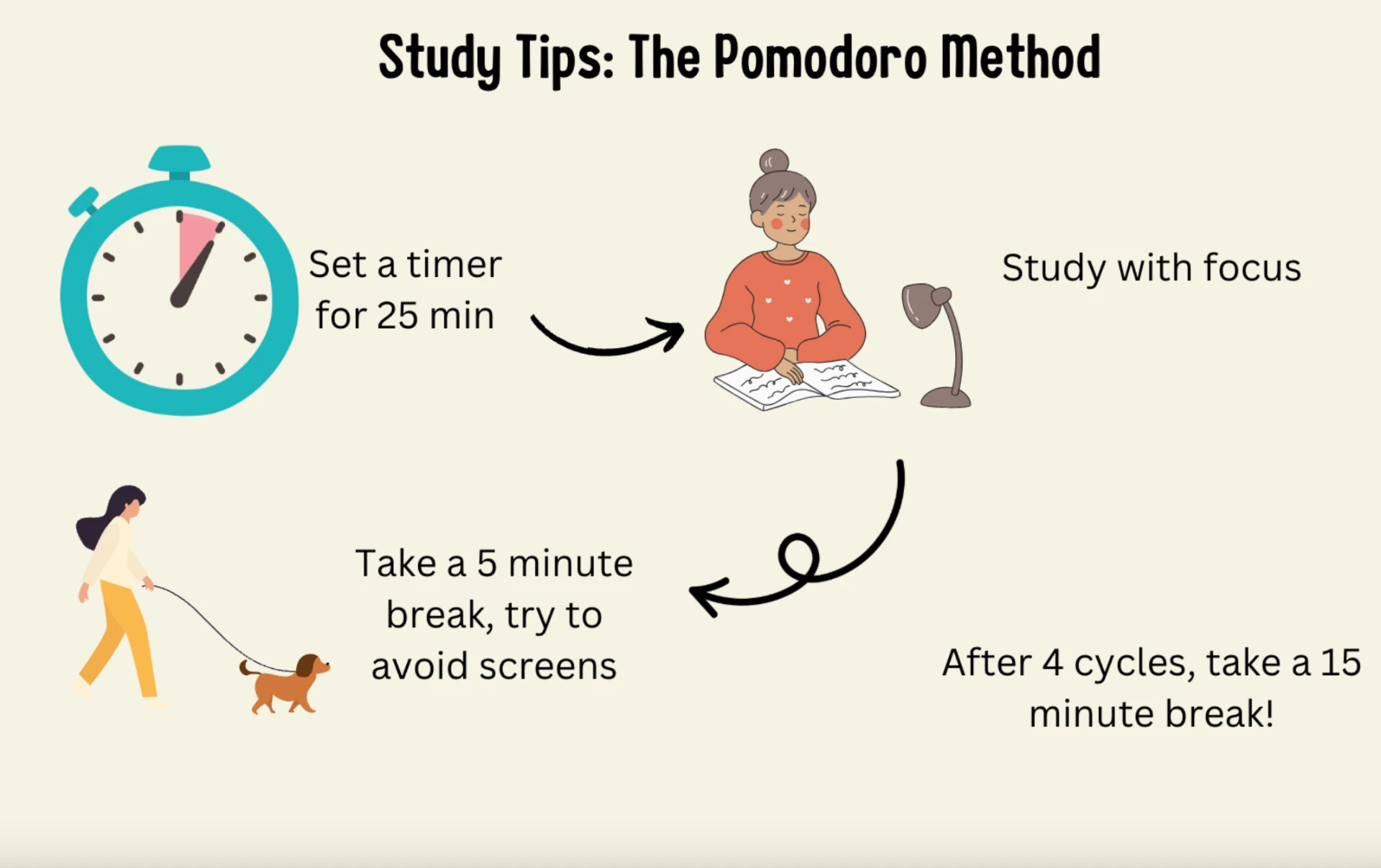
25 minutes of focused work, 5 minute break. Repeat. Great when starting feels hard.
Teach it to someone
If you can explain a concept simply to a friend (or your pet), you actually understand it.
Interleaving
Mix subjects in one study session instead of blocking. Builds flexible thinking and retention.
Practice tests
Old quizzes, end-of-chapter questions, flashcards. Testing yourself is studying, re-reading isn't.
A visual guide to the Pomodoro method: focus, then rest.
Time management
Use a planner
Paper or digital, write down every assignment, test, and deadline. Get it out of your head.
Break big tasks down
An essay isn't one task. It's: outline, draft intro, draft body, draft conclusion, edit. Schedule each.
Protect your sleep
Pulling all-nighters destroys memory and focus. A rested brain learns faster.
Schedule the hard subject first
Your willpower is highest in the first study block. Spend it on the class that scares you, not the easy one.
Batch similar work
All your reading in one block, all your problem sets in another. Switching costs add up.
Designing a workspace and routine
Pick a study spot
Same place, same time, when possible. A library table, a kitchen corner, even a specific chair signals your brain that it's time to focus.
Phone out of reach
Notifications fragment attention even when you ignore them. Drawer, other room, or in airplane mode while you study.
One open tab at a time
Close everything that isn't the assignment. Open tabs are open loops in your brain.
Plan tomorrow tonight
Three bullet points in your planner before bed. You wake up to a plan instead of a decision.
If you're new to the U.S. school system
GPAs, transcripts, AP/IB, FAFSA, SAT/ACT, dual enrollment, community college transfers, the system has its own language and unwritten rules. You're not behind for not knowing them yet. The fastest way through is to ask: school counselors, college access programs (TRIO, GEAR UP, College Possible, OneGoal, Bottom Line), and free advisors at your public library exist specifically for this. They are usually free and confidential.
Ask for help, it's a strength
Office hours, tutoring centers, librarians, and teachers exist to help you. Ask early, before you're drowning. A two-minute question now saves hours of confusion later. Most teachers will tell you the same thing: students who ask are the ones who do well.
- Khan Academy ↗
Free K–12 lessons in math, science, history, and SAT prep, available in many languages.
- Khan Academy en Español ↗
Full Khan curriculum translated into Spanish.
- FAFSA, Federal Student Aid ↗
The form that unlocks federal grants, work-study, and loans for college.
- Going Merry / Fastweb ↗
Free scholarship matching for high-school and college students.
- College Board BigFuture ↗
Free planning tools, college search, and scholarship database.